Best Lawn Sprinklers in 2026 for Even Summer Watering
Quick answer
Choose a lawn sprinkler by lawn shape, pressure, soil intake rate, local watering rules, and measured catch-can output. Brand claims matter less than whether the pattern covers turf evenly without runoff or overspray.
Common questions
- What sprinkler type is best for a rectangular lawn?
- An oscillating sprinkler is usually the simplest fit for a rectangular lawn because the spray pattern can match the shape with less overspray than a full-circle impact sprinkler.
- How do I know how long to run a hose-end sprinkler?
- Run a catch-can test, calculate the average depth after 15 minutes, and convert that result to inches per hour. Then adjust runtime for rainfall, soil runoff, allowed watering days, and turf condition.
- Is a smart hose-end sprinkler better than a regular sprinkler?
- It can help with scheduling and repeatability, but it still depends on placement, pressure, coverage, Wi-Fi reliability, and local restrictions. Measure output before trusting app runtime defaults.
Source note: Reviewed July 2026 against EPA WaterSense outdoor-water guidance and university extension catch-can audit methods. Product mentions are editorial examples, not hands-on lab tests or paid placements.
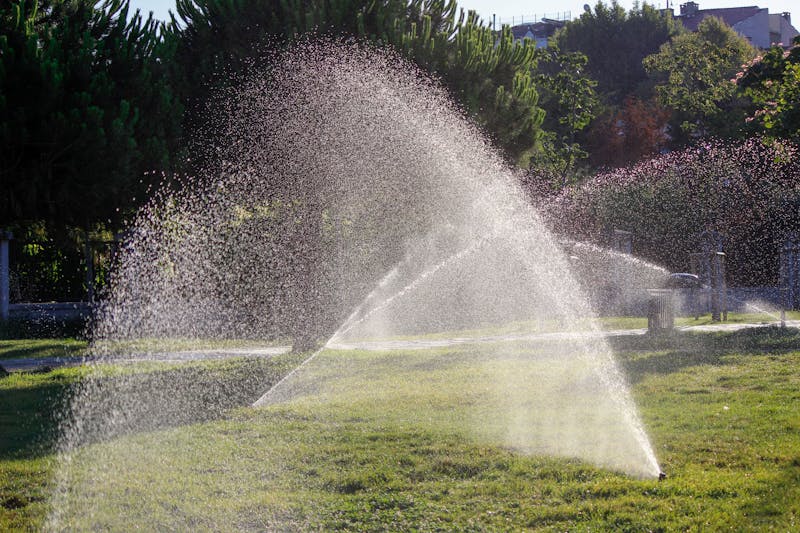
A lawn sprinkler looks simple until your yard starts showing the truth: one strip is soaked, the far corner is dry, the sidewalk is getting half the water, and your grass still wilts by dinner. The best lawn sprinkler is not just the one that throws water the farthest. It is the one that matches your lawn shape, pressure, soil intake rate, and how often you are willing to move it.
That matters most in summer, when a weak watering setup can waste water while still leaving shallow roots and heat-stressed turf. EPA WaterSense outdoor guidance emphasizes efficient irrigation, leak checks, and watering only when landscapes need it. A portable sprinkler can fit that goal, but only if you measure what it actually puts down.
This guide breaks down useful sprinkler types for 2026, where common models fit, and how to choose for small lawns, large open yards, irregular spaces, clay soil, and hands-off watering. Use the product examples as a selection framework, then verify coverage with your own catch-can test.
Quick Picks: Best Lawn Sprinklers for 2026
- Best overall: Melnor MiniMax Turbo Oscillating Sprinkler
- Best value oscillating sprinkler: Eden Turbo Oscillating Sprinkler
- Best for large open lawns: Melnor Pulsating Sprinkler with Tripod
- Best for very large yards: Orbit Traveling Sprinkler
- Best for small or irregular areas: Dramm ColorStorm 9-Pattern Turret Sprinkler
- Best durable impact sprinkler: Orbit Brass Impact Sprinkler on Spike
- Best budget sprinkler: Aqua Joe Oscillating Sprinkler
- Best smart hose-end sprinkler: Aiper IrriSense Smart Sprinkler
Sprinkler Selection Matrix
Start with the problem your current setup is failing to solve.
| Yard condition | Better sprinkler fit | Why it fits | Check before buying |
|---|---|---|---|
| Rectangular front lawn | Oscillating sprinkler | Straight spray path can match the turf shape | Width and range controls, stable base, nozzle cleaning access |
| Large open turf | Impact sprinkler or tripod impact | Longer throw and adjustable arc | Pressure, wind exposure, overlap pattern, tripod stability |
| Very large open run | Traveling sprinkler | Covers a hose path without constant resetting | Smooth route, slope, hose length, shutdown ramp |
| Narrow side yard or odd patch | Turret or pattern sprinkler | Smaller patterns reduce pavement overspray | Pattern options, low-flow control, footprint size |
| Clay soil or slope | Lower-output adjustable sprinkler | Slower application can reduce runoff | Ability to shorten cycles and repeat after soak time |
| Frequent missed watering | Smart hose-end sprinkler | Scheduling helps consistency | App support, Wi-Fi range, pressure, manual override |
If your yard has multiple shapes, one “best” sprinkler may be the wrong goal. Many lawns need a main sprinkler for broad turf and a smaller pattern sprinkler for strips, corners, and new repairs.
What Makes a Lawn Sprinkler Good?
A good sprinkler does four things well:
- Covers the intended area evenly without leaving obvious dry spots.
- Applies water slowly enough that it soaks in instead of running down the driveway.
- Adjusts to the actual lawn shape instead of wasting water on fences, sidewalks, and beds.
- Works with your water pressure, not just ideal test conditions.
Most established lawns need about 1 to 1.5 inches of water per week, including rainfall. The sprinkler’s job is to deliver that water evenly enough that roots grow deep instead of hovering in the top inch of soil. If you are still working out your weekly schedule, start with our full guide on how often to water your lawn.
EPA watering tips also recommend checking soil moisture, watering early, and avoiding overspray onto hard surfaces. Local drought rules or watering-day restrictions should override generic runtime advice.
1. Melnor MiniMax Turbo Oscillating Sprinkler: Best Overall
The Melnor MiniMax Turbo is the best portable sprinkler for most homeowners because it combines the even coverage of an oscillating sprinkler with much better adjustability than the old-school metal bar designs.
Traditional oscillating sprinklers are great for rectangular lawns, but many are frustrating when your yard is not a perfect rectangle. The MiniMax lets you adjust range and width, so you can narrow the spray for a side yard, shorten it near a sidewalk, or widen it across a broader patch of turf.
Best for:
- Small to medium lawns
- Rectangular or slightly irregular areas
- Homeowners who want one sprinkler that can move around the yard
- Avoiding overspray onto pavement
Why it works: The adjustment controls make it easier to water only the grass. That is a bigger deal than it sounds. Overspray is not just wasted water; it also means the lawn area you meant to water may be getting less than you think.
Watch out for: Like all oscillating sprinklers, performance drops if your water pressure is weak. If the spray barely reaches the edges of the pattern, shorten the range and water in more positions instead of trying to force one giant pass.
Bottom line: If you want one portable sprinkler to handle most residential lawn zones, this is the safest pick.
2. Eden Turbo Oscillating Sprinkler: Best Value Oscillating Sprinkler
The Eden Turbo Oscillating Sprinkler is a strong budget-friendly choice for homeowners who mostly water rectangular turf areas. It has a familiar oscillating pattern, simple controls, and enough coverage for many front lawns, backyards, and side strips.
Best for:
- Rectangular lawns
- Budget-conscious homeowners
- New homeowners building a basic lawn care setup
- Watering overseeded or newly repaired areas gently
Why it works: Oscillating sprinklers put down water in a soft, rain-like pattern. That is useful for new seed and young grass because the water lands gently instead of blasting soil or seed out of place.
Watch out for: Cheaper oscillating sprinklers can struggle with long-term durability if they are left outside in sun and grit all season. Rinse the nozzles occasionally and store it out of direct weather when you are not using it.
Bottom line: This is a practical first sprinkler for homeowners who want reliable rectangular coverage without spending much.
3. Melnor Pulsating Sprinkler with Tripod: Best for Large Open Lawns
For large, open lawns, an impact or pulsating sprinkler on a tripod is often a better tool than an oscillating sprinkler. The Melnor tripod model gets the spray head up above taller grass, low shrubs, and uneven terrain, helping the water travel farther with fewer blocked spots.
Best for:
- Large open lawns
- Uneven yards
- Tall grass during summer growth
- Areas where ground-level sprinklers get blocked
Why it works: Impact sprinklers throw water in a circular or partial-circle pattern. The tripod height improves reach and makes it easier to clear low obstacles. You can also adjust the arc so it waters a half circle, quarter circle, or full circle.
Watch out for: Impact sprinklers apply water unevenly if you rely on a single placement for a large area. The outer edge of the pattern may receive less water than the middle. Plan for overlap, just like an in-ground irrigation layout.
Bottom line: Choose this when distance and height matter more than perfect rectangular coverage.
4. Orbit Traveling Sprinkler: Best for Very Large Yards
The Orbit Traveling Sprinkler is a classic solution for big lawns where dragging and resetting a sprinkler every 30 minutes gets old fast. It uses water pressure to crawl along the path of your garden hose while spraying on both sides.
Best for:
- Large lawns without in-ground irrigation
- Long backyard runs
- Homeowners who do not want to manually move a sprinkler all afternoon
- Open turf with minimal obstacles
Why it works: Instead of watering one static circle, a traveling sprinkler follows a hose path. You can curve the hose around the lawn and let the sprinkler cover a long swath before shutting itself off at the end of the route.
Watch out for: Traveling sprinklers need enough water pressure and a reasonably smooth hose path. They are not ideal for steep slopes, tight corners, freshly seeded soil, or lawns cluttered with toys, roots, hoses, and edging.
Bottom line: If your biggest complaint is “my yard is too large for one sprinkler,” this is the portable option to look at before paying for a permanent system.
5. Dramm ColorStorm 9-Pattern Turret Sprinkler: Best for Small or Irregular Areas
The Dramm ColorStorm 9-Pattern Turret Sprinkler is not trying to be the highest-coverage sprinkler in the aisle. Its strength is control. The turret head gives you multiple spray patterns, making it useful for small lawn sections, narrow strips, garden edges, and odd-shaped patches.
Best for:
- Small lawns
- Side yards and narrow strips
- Spot watering dry areas
- Mixed lawn and garden spaces
Why it works: A pattern sprinkler is useful when a full oscillating or impact sprinkler is simply too much. You can choose a circle, semicircle, rectangle, strip, or other pattern depending on the area.
Watch out for: This is not the right sprinkler for a broad open lawn unless you enjoy moving it repeatedly. Treat it as a precision tool, not a whole-yard irrigation solution.
Bottom line: Buy this for the awkward areas your main sprinkler cannot water cleanly.
6. Orbit Brass Impact Sprinkler on Spike: Best Durable Impact Sprinkler
The Orbit Brass Impact Sprinkler on Spike is the simple, durable choice for homeowners who want an impact sprinkler without a tripod. Brass impact heads hold up better than lightweight plastic heads, especially if you use them often through summer.
Best for:
- Medium to large lawns
- Homeowners who prioritize durability
- Partial-circle watering along fences or property edges
- Connecting multiple sprinklers in a series when pressure allows
Why it works: Impact sprinklers are adjustable, repairable, and tolerant of normal outdoor abuse. The spike base is quick to reposition, and the spray arc can be dialed down to avoid watering the neighbor’s driveway.
Watch out for: The spike needs firm soil. In loose, wet, or sandy ground, it can lean and throw the pattern off. Step it in straight and check it after the water turns on.
Bottom line: This is a workhorse sprinkler for homeowners who want fewer plastic parts and more long-term toughness.
7. Aqua Joe Oscillating Sprinkler: Best Budget Sprinkler
The Aqua Joe Oscillating Sprinkler is a sensible budget pick for basic lawn watering. It is widely available, easy to understand, and works well for homeowners who need an affordable sprinkler for one or two lawn sections.
Best for:
- Entry-level lawn care kits
- Small and medium rectangular lawns
- Backup watering during dry spells
- Homeowners who only water occasionally
Why it works: Not every yard needs a premium sprinkler. If your lawn is simple, flat, and rectangular, a basic oscillating sprinkler can do the job as long as you measure output and move it before one area gets overwatered.
Watch out for: Budget sprinklers are more likely to have lighter bases and less precise adjustment controls. If your water pressure is strong, make sure the sprinkler stays planted and does not creep across the lawn.
Bottom line: A good low-cost pick if your watering needs are straightforward.
8. Aiper IrriSense Smart Sprinkler: Best Smart Hose-End Sprinkler
The Aiper IrriSense category is for homeowners who want some of the convenience of smart irrigation without installing a full in-ground sprinkler system. These smart hose-end systems use app controls and mapping features to water defined lawn areas from a movable unit.
Best for:
- Tech-forward homeowners
- Small to medium lawns without underground irrigation
- People who want scheduling without trenching
- Yards where one smart unit can cover the main turf area
Why it works: Smart hose-end sprinklers can reduce some of the manual work of portable watering. Depending on the setup, you may be able to map the watering area, schedule runs, and avoid watering when conditions are not right.
Watch out for: This is the premium option, and it is not a direct replacement for a well-designed in-ground system. Coverage depends heavily on placement, water pressure, Wi-Fi reliability, and whether the unit can see the whole area you expect it to water.
Bottom line: Consider this if you want automation but are not ready for a permanent sprinkler installation. If you already have underground zones, read our best smart sprinkler controllers guide instead.
How to Choose the Right Sprinkler Type
The right sprinkler depends more on lawn shape than brand.
Oscillating Sprinklers
Best for rectangular lawns. They create a back-and-forth fan of water and are usually the easiest sprinkler type for beginners. Use them on front lawns, back lawns, and freshly seeded areas where gentle water is important.
Impact and Pulsating Sprinklers
Best for large circular or partial-circle areas. They throw water farther than most oscillating sprinklers and handle open turf well. They are less precise near narrow borders unless you spend time adjusting the arc.
Traveling Sprinklers
Best for large lawns where you would otherwise move a sprinkler many times. They follow a hose path and cover a long route. They are clever, but they need open space and enough pressure.
Turret and Pattern Sprinklers
Best for small or odd-shaped areas. They are not always glamorous, but they solve real problems: side yards, garden edges, curb strips, and dry corners.
Smart Hose-End Sprinklers
Best for homeowners who want scheduling and app control without digging trenches. They cost more, but they can make sense for a small lawn that would be expensive or impractical to retrofit with permanent irrigation.
Match the Sprinkler to Your Soil
Soil type changes how aggressively you can water.
Clay soil absorbs water slowly. If a sprinkler applies water faster than the soil can take it in, you get runoff before the root zone is wet. Use lower-output sprinklers, shorter cycles, and a “cycle and soak” approach: water for 10 to 15 minutes, pause for 30 to 60 minutes, then water again.
Sandy soil drains quickly. It may need shorter, more frequent watering sessions because water moves beyond the root zone faster. An oscillating sprinkler or smart hose-end setup can work well because you can control shorter run times.
Loam soil is the easiest. It holds moisture but still drains well, so most sprinkler types can work as long as coverage is even.
If your lawn stays wet in some places and dry in others, the sprinkler may not be the only problem. Compaction, grading, thatch, and soil texture all affect irrigation. Our lawn aeration guide explains when opening the soil helps water reach the roots.
The Catch-Can Test: The Step Most Homeowners Skip
Do not guess how long to run a sprinkler. Measure it.
- Place 5 to 8 straight-sided containers around the watering area.
- Run the sprinkler for 15 minutes.
- Measure the water depth in each container.
- Average the measurements.
- Multiply by 4 to estimate inches per hour.
If your containers average 0.25 inches after 15 minutes, your sprinkler is applying about 1 inch per hour. If one container has 0.5 inches and another has almost nothing, you have a coverage problem, not a scheduling problem.
Move the sprinkler, shorten the range, or add overlap until the containers are reasonably close. This one test does more for lawn watering accuracy than any timer setting. The New Mexico State University catch-can audit method and the University of Minnesota home irrigation audit both use simple container measurements to compare output and coverage.
Sprinkler Audit Worksheet
Print or copy this table before changing runtime. It turns a sprinkler purchase into a measurable setup instead of a guess.
| Zone or area | Sprinkler type | 15-minute average depth | Highest can | Lowest can | Runoff seen? | Adjustment |
|---|---|---|---|---|---|---|
| Front rectangle | Oscillating | Narrow width or add overlap | ||||
| Side strip | Pattern/turret | Reduce pattern or move closer | ||||
| Back open lawn | Impact/tripod | Split into two placements |
Use the average depth to estimate output. For example, 0.20 inches in 15 minutes equals about 0.80 inches per hour. Then use the sprinkler output and watering schedule calculator to plan runtime around rainfall and allowed watering days.
Common Sprinkler Mistakes
Avoid these if you want deeper roots and fewer dry patches:
- Running one sprinkler too long in one spot: This creates puddles near the sprinkler and dry edges.
- Watering every day for a few minutes: Shallow watering encourages shallow roots.
- Ignoring wind: Even a good sprinkler performs poorly on windy afternoons.
- Watering at night: Wet grass overnight increases disease pressure, especially in humid summer weather.
- Letting overspray hit pavement: If water is on the sidewalk, it is not in the root zone.
- Skipping rainfall: Use a rain gauge so you know how much natural water your lawn already received.
The best watering window is usually early morning, when wind is lower and the grass has time to dry during the day. For more seasonal strategy, see our summer lawn care guide.
During heat waves, EPA WaterSense hot-weather guidance recommends checking irrigation systems, avoiding watering hardscape, and adjusting irrigation to actual landscape need instead of fixed habits.
If an in-ground zone continues flowing after the controller stops, protect the site first and follow the sprinkler valve will-not-shut-off workflow before opening a pressurized valve.
When a Portable Sprinkler Is Not Enough
A portable sprinkler is ideal when:
- You have a small or medium lawn
- You only need supplemental summer watering
- You rent or do not want to trench the yard
- You want a low-cost solution
An in-ground system starts making more sense when:
- You have a large property with multiple watering zones
- You travel often
- Your lawn has many separate areas
- You want consistent coverage without moving hoses
- Local water costs make precision especially valuable
If you are debating that upgrade, compare the cost and effort in our guide on how to install a sprinkler system. For garden beds, foundations, and shrubs, drip irrigation may be more efficient than overhead watering; start with our drip irrigation for landscaping guide.
Final Verdict: Which Lawn Sprinkler Should You Buy?
For most homeowners, the Melnor MiniMax Turbo Oscillating Sprinkler is the best first choice because it is adjustable, easy to move, and works well across common lawn shapes. If you have a large open yard, step up to a Melnor tripod impact sprinkler or an Orbit Traveling Sprinkler. For tight spaces and dry corners, keep a Dramm ColorStorm turret sprinkler on hand.
The bigger lesson is this: even the best lawn sprinkler only works if you measure its output and adjust coverage. Run the catch-can test, water in the morning, overlap patterns slightly, and aim for deep, infrequent watering instead of daily misting. Do that, and a simple hose-end sprinkler can keep a summer lawn healthier than many automatic systems running on bad settings.
Compare sprinklers by measured coverage, not only claims
These resources help connect sprinkler selection to catch-can output, lawn size, controller settings, and water restrictions.
- Sprinkler output and watering schedule calculator
Use a catch-can test after setup to set realistic runtime.
- How often to water your lawn
Compare sprinkler runtime against turf needs and rainfall.
- Best smart sprinkler controllers
Review controller options if manual runtime is hard to keep consistent.
- Sprinkler system installation guide
Compare portable watering with permanent zones, pressure, and coverage planning.
- Drip irrigation for landscaping
Use drip in beds and borders where overhead spray wastes water or wets foliage.
- Common lawn disease identification
Rule out disease and leaf-wetness patterns before assuming a different sprinkler alone will fix brown or thinning turf.
- Lawn diagnosis and irrigation log
Track dry spots, runoff, and disease-like patterns after sprinkler setup.

TurfTech HQ Editorial Team
Independent trade-focused editorial team