Common Lawn Weeds: Identification Guide with Pictures
You’re walking your lawn and notice something that doesn’t belong. Is it crabgrass or quackgrass? Clover or oxalis? Ground ivy or creeping Charlie? (Spoiler: those last two are the same weed — but more on that later.) Correct weed identification is the first and most important step in effective weed control, because the wrong herbicide won’t kill the weed and might harm your grass.
This guide covers 20+ of the most common lawn weeds in the United States. For each one, you’ll find key identifying features, growth habit information, and the most effective control methods — both chemical and organic.
Why Weeds Keep Appearing in Your Lawn
Before jumping into identification, it’s worth understanding why certain weeds keep showing up in the same spots year after year. Weeds are opportunists — they fill voids that your desirable lawn grass isn’t filling. Common triggers include:
- Bare or thin turf from drought, disease, pet damage, or foot traffic
- Compacted soil that limits grass root development
- Low mowing height that stresses cool-season grasses and exposes soil
- Soil pH imbalance — acidic soils (below 6.0) favor some weeds over most lawn grasses
- Excessive moisture or poor drainage — encourages sedges, moss, and creeping weeds
- Nutrient deficiency — stressed grass loses competitive advantage
The best long-term weed prevention strategy is a dense, healthy, properly maintained lawn. Herbicides are a tool, but they’re most effective when the underlying conditions that invite weeds are also addressed.
Broadleaf Weeds
Broadleaf weeds (dicots) have wide leaves with visible net-like vein patterns and are generally easier to control selectively than grassy weeds. Most common broadleaf weed killers containing 2,4-D, MCPP, and dicamba work well on this category.
1. Dandelion (Taraxacum officinale)
Identifying features:
- Deeply toothed (lobed) leaves that form a flat rosette
- Hollow stem with a single bright yellow flower
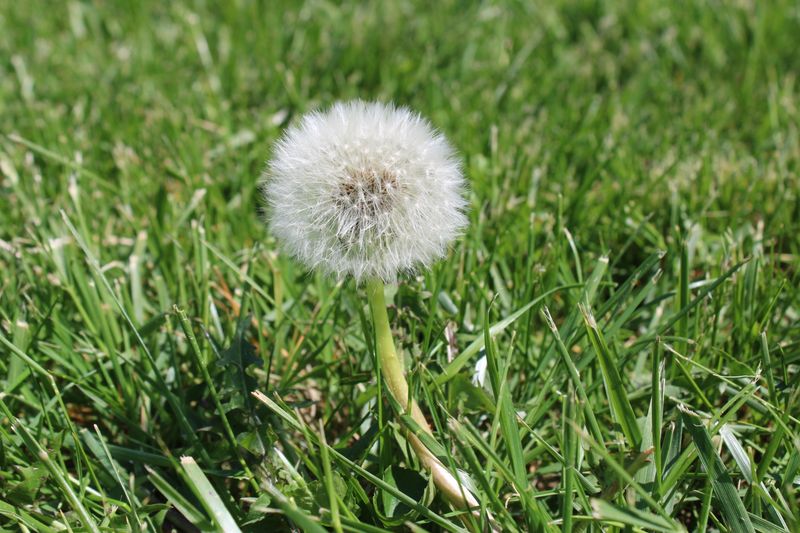
- White, globe-shaped seed head (“puffball”) that spreads seeds by wind
- Deep, thick taproot (often 6–18 inches long)
- Leaves are hairless and shiny
Growth habit: Perennial. Grows year-round in mild climates; dies back in winter and returns from the taproot each spring.
Why it’s a problem: The deep taproot is very difficult to pull completely. If any taproot fragment remains, the plant regrows. Each seed head releases up to 200 seeds.
Best control:
- Post-emergent herbicide: 2,4-D-based products (Ortho WeedClear, Spectracide Weed Stop) work well on dandelions. Fall application (September–October) is particularly effective when dandelions are actively translocating nutrients to their roots.
- Organic: Use a Fiskars Stand-Up Weeder (Amazon) to extract the full taproot. Pull when soil is moist.
- Prevent: Dense, thick turf through overseeding limits dandelion establishment.
2. Crabgrass (Digitaria sanguinalis / D. ischaemum)
Identifying features:
- Wide, flat blades (much wider than lawn grass); light to yellowish-green color
- Grows in a low, spreading rosette pattern, radiating outward from a central clump
- Stem lies flat along the ground; nodes can root where they touch soil
- Finger-like seed heads in mid-to-late summer
- Hairy leaf sheaths and blades (large crabgrass, D. sanguinalis)
Growth habit: Warm-season annual. Germinates when soil temperatures reach 55°F; dies with first frost. Each plant produces up to 150,000 seeds.
Best control:
- Pre-emergent (best approach): Apply pre-emergent herbicide (Scotts Halts/pendimethalin, Barricade/prodiamine, or Dimension/dithiopyr) when soil temps approach 55°F
- Post-emergent: Quinclorac (Drive XLG, Bayer All-in-One) or mesotrione (Tenacity) on young plants
- Organic: Corn gluten meal as pre-emergent; hand-pulling before seed heads form
3. White Clover (Trifolium repens)
Identifying features:
- Three rounded leaflets (occasionally four — the “lucky” four-leaf clover) per leaf stem
- White, globe-shaped flower heads; attractive to bees
- Spreading, creeping growth habit; roots at nodes along stems
- Leaves often have a distinctive lighter “V” or chevron mark
Growth habit: Perennial. Spreads by seed and by rooting at stem nodes. Very common in lawns with low nitrogen fertility — clover fixes its own nitrogen.
Best control:
- Post-emergent herbicide: Clover is resistant to standard 2,4-D formulations. Use a triclopyr-containing product (Bonide Weed Beater Ultra, Ortho Clover & Ground Ivy Killer) for best results
- Cultural: Apply nitrogen fertilizer to bring lawn nitrogen levels up — higher nitrogen reduces clover’s competitive advantage
- Organic: Hand-pull patches before they spread; improve turf density
4. Chickweed (Stellaria media — Common; Cerastium fontanum — Mouse-ear)
Identifying features:
- Common chickweed: Small, oval, bright green leaves; tiny star-shaped white flowers; forms dense mats in cool, moist areas; stems have a single line of fine hairs
- Mouse-ear chickweed: Similar but hairier leaves; slightly thicker; perennial vs. common chickweed’s annual habit
Growth habit: Common chickweed is a cool-season annual; germinates in fall and early spring, sets seed, and dies when summer heat arrives. Mouse-ear chickweed is a perennial.
Best control:
- Post-emergent herbicide: Standard three-way broadleaf killers (2,4-D/MCPP/dicamba) work well. Apply in fall when chickweed is actively growing.
- Pre-emergent: Prodiamine (Barricade) in early fall prevents cool-season annual chickweed germination
- Organic: Hand-pulling is easy — chickweed has very shallow roots and uproots cleanly when pulled
5. Ground Ivy / Creeping Charlie (Glechoma hederacea)
Identifying features:
- Rounded, scalloped-edge leaves with a distinctive mint-like aroma when crushed
- Square stems (a trait of the mint family)
- Small purple-blue flowers in spring
- Spreads aggressively by above-ground stolons (runners)
- Low-growing, mat-forming
Growth habit: Perennial. One of the most aggressive and difficult-to-control broadleaf lawn weeds. Spreads rapidly via stolons in shaded, moist areas.
Best control:
- Post-emergent herbicide: Standard 2,4-D products have limited effectiveness on ground ivy. Triclopyr is the key ingredient — Bonide Weed Beater Ultra or products containing triclopyr + 2,4-D + dicamba. Multiple applications (3–4 weeks apart) typically needed.
- Timing: Fall application is most effective when plants are moving carbohydrates to roots
- Organic: Hand-pulling is labor-intensive but works on small patches if done consistently; improve shade tolerance of the area by overseeding with shade-tolerant grass varieties
6. Bindweed (Convolvulus arvensis)
Identifying features:
- Arrow-shaped leaves with pointed or slightly indented base lobes
- Twining, vining growth habit — wraps around other plants
- White to pink funnel-shaped flowers (like a small morning glory)
- Extremely deep root system (can reach 10–20 feet deep)
Growth habit: Perennial. One of the most difficult-to-eradicate weeds due to its deep root system and extensive underground rhizome network.
Best control:
- Post-emergent herbicide: Glyphosate (non-selective) is most effective for serious infestations in non-lawn settings. In lawns, repeat applications of 2,4-D + dicamba products will suppress but rarely eradicate bindweed — the deep roots allow regrowth
- Persistence: No single application kills bindweed. A multi-year program of repeated treatments that deplete root energy reserves is required
- Organic: Repeated cutting to deplete root energy; solarization can help in cleared areas
7. Oxalis (Oxalis stricta / O. corniculata)
Identifying features:
- Three heart-shaped leaflets per leaf (resembles clover but leaflets are heart-shaped, not rounded)
- Yellow five-petaled flowers
- Seed pods that explode and scatter seeds when touched at maturity
- Leaves may be green or purple-tinged depending on species
Growth habit: Annual or perennial depending on species. Yellow woodsorrel (O. stricta) is an annual; creeping oxalis (O. corniculata) is a perennial with purple leaves and a more aggressive spreading habit.
Best control:
- Post-emergent herbicide: 2,4-D/MCPP/dicamba products provide moderate control; a triclopyr-containing product works better on persistent oxalis
- Timing: Apply when plants are young and actively growing
- Organic: Hand-pull before seed pods mature (seed pods are the main dispersal mechanism)
8. Plantain (Plantago major / P. lanceolata)
Identifying features:
- Broadleaf plantain (P. major): Wide, oval leaves in a flat rosette; prominent parallel veins; leaf stalks are often reddish at the base; tough, fibrous taproot
- Buckhorn plantain (P. lanceolata): Long, narrow lance-shaped leaves; ribbed veins; grows in a similar rosette pattern
Growth habit: Perennial. Tolerates compacted soil better than most lawn grasses — its presence often indicates soil compaction.
Best control:
- Post-emergent herbicide: Responds well to 2,4-D-based products
- Cultural: Core aerate to relieve compaction; improves lawn grass competitiveness
- Organic: Dandelion diggers work well on plantain taproots; soil aeration reduces future establishment
9. Henbit (Lamium amplexicaule)
Identifying features:
- Rounded, scalloped leaves; upper leaves clasp directly around the square stem (no leaf stalk)
- Purple, tubular flowers in early spring
- Square stems (mint family)
- Low-growing annual
Growth habit: Cool-season annual. Germinates in fall, overwinters as a rosette, flowers and sets seed in early spring, then dies with summer heat.
Best control:
- Pre-emergent: Fall pre-emergent application (prodiamine/Barricade) prevents germination
- Post-emergent herbicide: 2,4-D-based products; apply in fall or early spring when plants are young and actively growing
- Organic: Easy to hand-pull due to shallow roots; pull in early spring before seed sets
10. Thistle (Cirsium spp.)
Identifying features:
- Spiny, deeply lobed leaves — very distinctive and unmistakable
- Purple (occasionally white) globe-shaped flowers on tall stalks
- Seeds with feathery “parachute” appendages (pappus) for wind dispersal
Growth habit: Biennial or perennial. First year: rosette only. Second year: bolt and flower. Deep taproot.
Best control:
- Post-emergent herbicide: 2,4-D products work well, especially on young rosettes in first year
- Timing: Treat in fall of first year or early spring before bolting
- Organic: Cut below the soil surface using a sharp spade — repeat as needed to deplete root energy; wear thick gloves
11. Purslane (Portulaca oleracea)
Identifying features:
- Succulent, paddle-shaped leaves; reddish succulent stems that lie flat on the ground
- Thick, waxy leaves that store water
- Small yellow flowers
- Forms dense mats in hot, dry, sunny areas
Growth habit: Warm-season annual. Thrives in heat and drought — conditions that stress lawn grasses.
Best control:
- Post-emergent herbicide: 2,4-D/MCPP/dicamba products provide control; waxy leaves may reduce herbicide uptake — add a surfactant for better coverage
- Organic: Pull before seed sets; do NOT leave pulled plants on the soil surface — stems re-root easily in moist conditions. Bag and discard.
12. Dollarweed (Hydrocotyle umbellata)
Identifying features:
- Round, coin-shaped leaves with the stem attached at the center of the leaf (like an umbrella)
- Shiny, waxy green leaves; scalloped edges
- Spreads via underground rhizomes, seeds, and stem fragments
Growth habit: Perennial. Thrives in wet, overwatered lawns — consistently overwatered lawns in warm climates (Southeast, Gulf Coast) are prime habitat.
Best control:
- Herbicide: Atrazine is particularly effective; sulfentrazone-containing products also work well. Southern Ag Atrazine is a common choice for warm-season lawns
- Cultural (critical): Reduce irrigation frequency. Dollarweed thrives in persistently wet soil. Improving drainage and watering deeply-but-infrequently dramatically reduces dollarweed pressure
- Organic: Hand-pull consistently; improve drainage
Grassy Weeds
Grassy weeds (monocots) look similar to lawn grasses and are much more difficult to control selectively. They require different herbicides from broadleaf weed killers.
13. Goosegrass (Eleusine indica)
Identifying features:
- Similar to crabgrass but with a distinctive silvery-white center where the blades meet
- Flat, compressed stem bases; dark green color
- Grows in a flat, star-shaped rosette
- Seed heads: zipper-like spikes in 2–3 rows
- Germinates 2–3 weeks later than crabgrass; thrives in compacted soils
Growth habit: Warm-season annual. Common in compacted, high-traffic areas — athletic fields, paths, driveways edges.
Best control:
- Pre-emergent: Prodiamine (Barricade) is effective; apply slightly later than for crabgrass due to later germination
- Post-emergent: Fenoxaprop (Acclaim Extra) provides better control than quinclorac for goosegrass
- Cultural: Core aerate to relieve compaction — this is essential for long-term goosegrass control
14. Nutsedge (Cyperus esculentus — yellow; C. rotundus — purple)
Identifying features:
- Triangular stem — the key identifying feature (“sedges have edges”; roll the stem between your fingers)
- Bright yellow-green or dark green leaves; grows faster than surrounding turf
- Leaves arise in sets of three from the stem base (grass leaves are opposite)
- Produces underground tubers (“nutlets”) — the main challenge in control
Growth habit: Perennial sedge (technically not a grass, though it looks like one). Spreads via tubers, rhizomes, and seeds. A single plant can produce hundreds of tubers.
Best control:
- Post-emergent herbicide: Halosulfuron-methyl (Ortho Nutsedge Killer, Sedgehammer) is the most effective consumer option; sulfentrazone (Certainty) is a professional-grade option
- Multiple applications required: Tubers sprout even after the parent plant is killed; plan for 2–3 treatments spaced 3–4 weeks apart
- Cultural: Improve drainage; nutsedge thrives in wet, poorly-drained soil
15. Quackgrass (Elymus repens)
Identifying features:
- Medium-width blades; bluish-green color
- Distinctive clasping auricles at the leaf-stem junction (like small “fingers” wrapping the stem)
- Creeping underground rhizomes — pale white, branching, wiry
- Seed head resembles wheat
Growth habit: Cool-season perennial. Spreads aggressively via rhizomes; each rhizome fragment can produce a new plant.
Best control:
- No selective herbicide effectively kills quackgrass in an established lawn without harming the turf
- Glyphosate spot treatment: Use a foam roller or foam paintbrush to apply glyphosate directly to quackgrass foliage without contacting surrounding grass; allow 2 weeks for full kill; reseed area
- Organic: Repeated digging to remove rhizomes; solarization for large infestations
- Prevention: Do not till rhizome-infested soil — this spreads fragments
16. Annual Bluegrass / Poa Annua (Poa annua)
Identifying features:
- Light green, fine-textured blades; boat-shaped leaf tip
- Distinctive whitish seed head that appears very early (even in short-cut lawns)
- Grows in bunches or patches
- Very common in cool, moist conditions
Growth habit: Cool-season annual (some biotypes behave as short-lived perennials). Germinates in late summer/fall; grows actively in cool seasons; dies with summer heat.
Best control:
- Pre-emergent: Fall application of prodiamine (Barricade) or pendimethalin (Scotts Halts) prevents germination — apply in early-to-mid fall before soil temps drop below 70°F
- Post-emergent: Ethofumesate (Prograss) is used by professionals; mesotrione (Tenacity) provides some suppression
- Cultural: Reduce soil disturbance; poa annua thrives in disturbed areas
17. Creeping Bentgrass (Agrostis stolonifera)
Identifying features:
- Very fine, velvety texture; lighter green than surrounding turf
- Grows in circular or irregular light-colored patches
- Forms dense, felt-like mats at low mowing heights
- Has stolons (above-ground runners) and shallow roots
Growth habit: Cool-season perennial. Common as an invasive grass in bluegrass and fescue lawns; appears as off-color, flat patches.
Best control:
- Mesotrione (Tenacity): Bleaches bentgrass tissue white before killing it; multiple applications required; safe for Kentucky bluegrass
- Glyphosate spot treatment: Spot spray with glyphosate, allow to fully die, then overseed; most reliable elimination method
Sedges and Other Problem Weeds
18. Wild Violet (Viola sororia)
Identifying features:
- Heart-shaped to kidney-shaped dark green leaves
- Purple, blue, or white flowers in spring
- Waxy, glossy leaf surface (makes herbicide application less effective without surfactant)
- Fibrous root system with thick rhizomes
Growth habit: Perennial. Spreads by seed and rhizomes; thrives in shaded, moist areas.
Best control:
- Herbicide: Triclopyr is essential — standard 2,4-D products have poor efficacy on wild violet. Use Bonide Weed Beater Ultra or Ortho Clover, Oxalis & Ground Ivy Killer
- Add surfactant: The waxy leaf surface repels water-based herbicides; always add a non-ionic surfactant
- Timing: Fall application is most effective; multiple treatments needed
19. Knotweed (Polygonum aviculare)
Identifying features:
- Small, lance-shaped blue-green leaves; papery, sleeve-like sheath at each leaf joint
- Low-growing, prostrate; forms mats along paths, driveways, compacted areas
- Tolerates foot traffic exceptionally well
Growth habit: Annual. Germinates early in spring; grows throughout summer in compacted, high-traffic areas.
Best control:
- Pre-emergent: Early spring pre-emergent application before soil temps hit 50°F
- Post-emergent herbicide: 2,4-D/MCPP/dicamba; apply when young
- Cultural: Core aerate to relieve compaction — knotweed is strongly associated with compacted soil
20. Annual Bluegrass / Wintergrass — see #16 above
Bonus: Spurge (Euphorbia maculata / E. supina)
Identifying features:
- Small, oval leaves often with a reddish spot in the center
- Forms dense, low-growing mats
- Produces a milky white latex sap when stems are broken — distinctive identification trait
- Reddish stems
Growth habit: Warm-season annual. Thrives in thin, dry lawns in hot weather; spreads quickly in mid-to-late summer.
Best control:
- Post-emergent herbicide: 2,4-D/MCPP/dicamba products; add surfactant for waxy leaf surface
- Organic: Hand-pull before seed set; be aware that the milky sap can irritate skin
- Cultural: Dense turf and consistent moisture prevent establishment
General Weed Prevention: The Big Picture
No matter which weeds you’re dealing with, these cultural practices form the foundation of long-term weed prevention:
- Mow at the correct height — 3–4 inches for cool-season grasses to shade soil and suppress germination
- Overseed bare and thin spots immediately — every empty space is an opportunity for weeds
- Core aerate annually — relieves compaction, improves drainage, boosts turf competitiveness
- Soil test every 2–3 years — correct pH imbalances that favor weeds over grass
- Water deeply and infrequently — 1 inch per week in a single session, not daily shallow watering
- Apply pre-emergent herbicide at the correct timing — prevents annual weed seeds from germinating
Helpful tool: The iNaturalist app (free) and PictureThis app (Amazon/App Store) use AI-powered photo recognition to help identify unknown weeds from photos. Both are excellent supplements to this guide.
Conclusion
Identifying weeds correctly before treating them is the single most important step in effective weed control. Once you know what you’re dealing with — whether it’s a broadleaf perennial like wild violet (which needs triclopyr), a grassy annual like crabgrass (which needs a pre-emergent), or a sedge like nutsedge (which needs halosulfuron) — you can choose the right product and apply it at the right time for maximum effectiveness.
Keep this guide bookmarked for reference throughout the growing season. The more you learn to recognize these plants early, before they flower and set seed, the easier your lawn management becomes each year.

TurfTech HQ Editorial Team
Independent trade-focused editorial team