How to Lay Sod: Step-by-Step Installation Guide
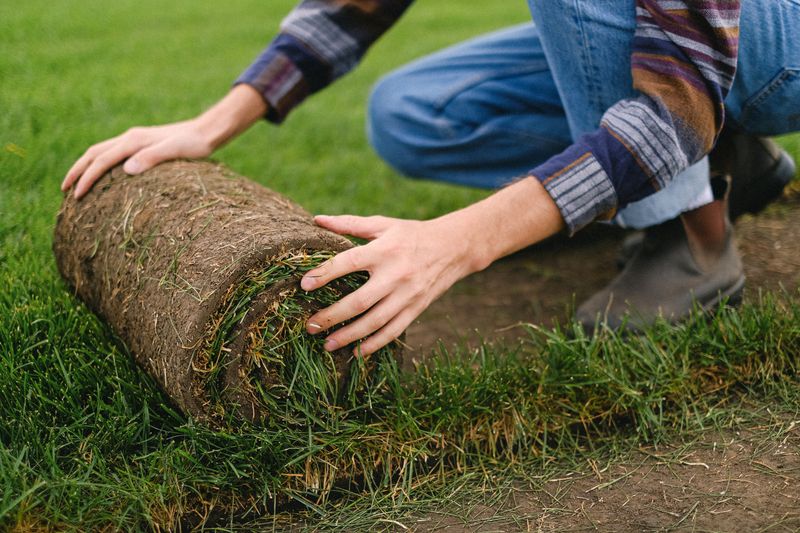
There are few things more satisfying in the landscape world than watching a bare patch of dirt transform into a lush, green lawn in a single afternoon. That’s the promise of sod — and when installed correctly, it delivers. You get an instant lawn, virtually no weed pressure in those first critical weeks, and a head start on establishment that seed can’t match.
But laying sod is more than just rolling out rectangles of grass. The difference between sod that thrives and sod that fails almost always comes down to site preparation, proper installation technique, and the watering schedule in those first two weeks. Get those three things right and you’ll have a lawn people stop to admire. Miss any of them and you’ll be patching dead squares and wondering what went wrong.
This guide walks you through the entire sod installation process from start to finish — including when sod beats seed, how to calculate what you need, site prep requirements, step-by-step installation, and the critical post-installation care that determines success.
Sod vs. Seed: Which Is Right for Your Project?
Before you order a pallet, it’s worth understanding when sod makes sense and when seeding might be the better call.
When Sod Makes More Sense
- You need immediate results — sod is fully functional in 3–4 weeks vs. 3–6+ months for a seeded lawn to mature
- Erosion control is needed — sod stabilizes slopes and disturbed soil immediately; seed washes away
- Weed suppression is a priority — a properly laid sod installation shuts out weeds during the critical establishment period
- Large bare areas from construction, landscaping, or pest damage need quick restoration
- The project is highly visible — front yards, entertaining areas, or newly landscaped beds where bare soil looks bad
When Seed May Be the Better Choice
- Budget is the primary constraint — sod typically costs 5–10x more than seed per square foot installed
- Very large areas (5,000+ sq ft) where seed is economically the only practical option
- Unusual or specialty grass types that aren’t commercially available as sod in your area
- Low-traffic areas where you can protect young seedlings and don’t need quick results
Cost Comparison
Sod typically runs $0.35–$0.85 per square foot for the material itself, with professional installation adding another $0.50–$1.00 per sq ft in labor. DIY installation with rented equipment drops total cost significantly.
Quality grass seed for overseeding or full renovation runs $0.05–$0.20 per square foot in seed cost alone, though starter fertilizer, aeration, and equipment rental add to the total.
Step 1: Calculate How Much Sod You Need
Accurate measurement saves you from two expensive mistakes: running short mid-installation (your sod supplier may not have more of the same batch) or vastly over-ordering and wasting money.
Measuring Your Area
For rectangular areas: Length (ft) x Width (ft) = Square footage
For irregular shapes: Break the area into rough rectangles or triangles, calculate each, and add together.
Use a measuring wheel for accurate results on larger lawns — pacing or estimating introduces significant error.
Adding the Waste Factor
Always order 5–10% more sod than your calculated square footage to account for:
- Cuts at borders, curves, and obstacles
- Damaged pieces at the edges of pallets
- Mistakes during installation
- Small patches needed around sprinkler heads, trees, and other features
For simple rectangular lawns: Add 5% to your calculated area. For irregular shapes with curves, islands, and obstacles: Add 10%.
Sod Units
Most sod is sold in:
- Rolls (typical residential sod): 2 feet x 5 feet = 10 sq ft per roll
- Slabs/pieces (some varieties): 16” x 24” or similar dimensions
- Pallets: Usually cover 450–500 sq ft per pallet (50 rolls)
Divide your total square footage (including waste factor) by 10 to get the number of rolls needed, then divide by 50 to determine pallet count.
Step 2: Choose the Right Sod Variety
Not all sod is grown equally, and choosing the wrong variety for your climate and site conditions leads to long-term problems.
Cool-Season Grasses (Northern Regions, Zone 6 and Below)
- Kentucky Bluegrass: The premium cool-season sod grass. Beautiful dark green color, excellent recovery from traffic, spreads by rhizomes to fill in gaps. Needs full sun and at least 4–5 hours of direct sunlight.
- Tall Fescue: Excellent heat and drought tolerance for a cool-season grass; performs well in the transition zone (Zones 6–7). Bunch-type growth (doesn’t spread), so damage requires re-sodding or overseeding.
- Perennial Ryegrass Blends: Fast establishment, wear tolerance, and deep green color. Often blended with bluegrass for the best of both.
Warm-Season Grasses (Southern Regions, Zone 7 and Above)
- Bermudagrass: The most heat- and drought-tolerant warm-season option. Aggressive spreader, excellent wear tolerance, thrives in full sun. Goes dormant (brown) in winter.
- Zoysia: Dense, soft texture, good shade tolerance for a warm-season grass. Slower to establish but extremely durable once established.
- St. Augustine: The dominant grass in humid southern climates. Best shade tolerance of any warm-season grass. Coarser texture; not cold-hardy.
- Centipede: Low-maintenance, low-fertilizer warm-season grass for the Southeast. Don’t over-fertilize — it’s often killed by kindness.
Ask your sod farm what varieties they grow and request one matched to your sun exposure, soil type, and maintenance tolerance.
Step 3: Site Preparation — The Most Important Step
This is where most DIY sod installations either succeed or fail. Sod laid on poorly prepared soil never fully roots down and will struggle or fail within the first summer. Take the time to do this right.
Remove Existing Vegetation
All existing grass, weeds, and vegetation must be completely eliminated before sod goes down.
Option 1 — Herbicide: Apply a non-selective herbicide like glyphosate (Roundup) 7–14 days before installation. This kills everything down to the roots. Wait until vegetation is fully brown before proceeding.
Option 2 — Sod cutter: Rent a sod cutter (available at most equipment rental stores for $80–$120/day) to strip the existing turf. This is the fastest mechanical method and removes material cleanly. Dispose of stripped turf in a compost pile or yard waste bags.
Option 3 — Smothering: Cover the area with cardboard or black plastic sheeting for 4–6 weeks to smother existing vegetation. Works but requires advance planning.
Till the Soil
After removing vegetation, till the top 4–6 inches of soil using a rototiller (rentable for $60–$100/day). Tilling:
- Breaks up compacted soil layers that sod roots struggle to penetrate
- Incorporates organic matter and amendments evenly
- Creates the loose, friable seedbed that promotes rapid rooting
Till in two passes at perpendicular directions for thorough, even soil loosening.
Test and Amend Your Soil
A soil test (available from your local extension office or as an at-home kit) reveals pH and nutrient deficiencies before you install. Correcting problems now is infinitely easier than trying to amend under established sod.
- Target soil pH: 6.0–7.0 for most grasses (bermuda tolerates slightly higher)
- Low pH (acidic): Incorporate lime into the top 4 inches while tilling
- High pH (alkaline): Incorporate sulfur
- Poor soil structure: Incorporate 2–3 inches of compost while tilling — this is one of the highest-impact investments you can make for long-term lawn health
Apply a starter fertilizer (high phosphorus — look for an analysis like 18-24-6) at this stage and till it into the top few inches. Phosphorus promotes root development, which is exactly what new sod needs.
Grade for Drainage
After tilling and amending, the soil surface needs to be graded so water drains away from structures (house foundation, walkways, patios). General target slope is 1–2% away from structures — about 1 inch of fall per 8 feet.
Use a landscape rake to rough-grade, then a lawn roller (filled one-third with water) to firm the surface. Roll in two perpendicular directions.
Final grade should be approximately ½–¾ inch below adjacent hard surfaces (driveways, sidewalks, edging) to account for the thickness of the sod.
Final Raking
After rolling, do a final pass with a landscape rake to break up any remaining clods and create a smooth, even surface. Remove rocks larger than 1 inch, remaining debris, and old roots. The surface should look like a well-prepared garden bed.
Step 4: Order Sod — Timing and Logistics
When to Install Sod
The best times to lay sod:
- Cool-season grasses: Early fall (September–October) or early spring (April–May). Fall is preferred — soil is warm for root establishment but air temperatures are cooling, reducing heat stress.
- Warm-season grasses: Late spring through early summer (May–July) when soil is warm and grass is actively growing. Avoid laying warm-season sod in fall — it won’t establish before dormancy.
Avoid installing sod during extreme heat (over 95°F), drought conditions, or when soil is frozen or saturated.
Coordinate Same-Day Delivery and Installation
Order sod for the same day you plan to install. Fresh sod should go from delivery to ground within 24 hours — 12 hours is better. Sod sitting on pallets in summer heat begins to deteriorate rapidly.
Confirm your total square footage, add the waste factor, and place your order 5–7 days in advance to ensure the farm has your variety ready.
Step 5: Install the Sod — Step-by-Step
With your site prepared and sod delivered, installation moves quickly. Have help on hand — sod is heavy (rolls typically weigh 15–30 lbs each) and having a second person dramatically speeds the work.
1. Start at a Straight Edge
Begin laying sod along the longest straight edge on your property — a driveway, sidewalk, fence line, or house foundation. A straight starting edge makes everything else easier to align.
Lay the first row completely, butting pieces end-to-end with no gaps and no overlaps. Gaps dry out and die; overlaps create ridges.
2. Stagger the Seams Like a Brick Pattern
Start the second row with a half-length piece so that the joints in the second row fall over the center of pieces in the first row — exactly like a brick wall pattern. This staggered joint pattern:
- Prevents long seam lines that create visible stripes in the finished lawn
- Improves structural stability of the sod mat
- Reduces the chance of seam gaps opening up during establishment
Continue with this offset pattern for every row.
3. Keep Joints Tight
Press each piece firmly against its neighbors — seams should be barely visible, not gapped. Use a sharp sod knife (or a straight-edge knife) to trim pieces to fit at borders, curves, obstacles, and landscape beds.
- At curves: Lay the sod, then cut to the curve from above using your sod knife. A flexible garden hose can serve as a cutting guide for smooth curved edges.
- Around sprinkler heads: Use a circle cutter or sod knife to cut small round holes before laying — much easier than trying to cut around a head after the roll is down.
- Avoid small pieces at edges: If your last row requires very small pieces (less than 6 inches wide), reposition the row to use larger pieces at edges and smaller in the interior.
4. Roll the Finished Sod
After installation is complete, go over the entire area with a lawn roller filled approximately one-third with water. Rolling:
- Ensures full soil contact across the entire sod mat — the single most critical factor for successful rooting
- Presses out air pockets beneath the sod
- Levels minor surface irregularities
Roll in two perpendicular directions for complete, even contact.
5. Begin Watering Immediately
Do not wait to water. Begin irrigation within 30 minutes of completing installation — or water as you go in sections during the installation if the area is large (over 1,000 sq ft).
Step 6: Post-Installation Watering Schedule
The first 14 days are make-or-break for sod establishment. The sod’s existing root system was cut when it was harvested and must regenerate new roots into your prepared soil before it can sustain itself. During this window, the sod has almost no ability to draw water from depth — it is entirely dependent on the moisture you supply.
Week 1–2: Keep the Soil Consistently Moist
- Water 2–3 times per day in warm weather (above 80°F)
- Each watering should wet the top 1–2 inches of soil beneath the sod — lift a corner of a piece and check
- Sod should never feel dry or show signs of rolling edges, which indicate moisture stress
- Avoid puddling and runoff — water less per cycle and more frequently if water pools before absorbing
In cooler weather (below 70°F), once daily may be sufficient. The goal is consistent moisture in the sod root zone — neither saturated nor dry.
Week 3–4: Transition to Deep, Less Frequent Watering
Once the sod begins rooting down (test by gently tugging a corner — resistance indicates root establishment), begin transitioning to deeper, less frequent irrigation:
- Reduce frequency to once daily, then every other day
- Increase duration per cycle to encourage deeper root growth
- By the end of week 4, target deep watering (reaching 4–6 inches) 2–3 times per week
Watering After Full Establishment (6+ Weeks)
After sod is fully established (typically 6–8 weeks after installation), water like any mature lawn:
- 1–1.5 inches per week total (including rainfall)
- Deep, infrequent irrigation: 2–3 times per week rather than daily
- Early morning watering to reduce disease pressure
Step 7: First Mow and Ongoing Care
When to Mow for the First Time
Wait until the sod has rooted sufficiently before mowing. Test by grabbing and pulling a section of sod firmly. If it lifts up with no resistance, it hasn’t rooted yet — wait.
Once the sod resists pulling, it’s ready for the first mow. This typically occurs 2–3 weeks after installation, though it can range from 10 days to 4 weeks depending on weather, species, and soil temperature.
First mow guidelines:
- Never remove more than one-third of the blade height in a single mowing
- If sod was installed at 3 inches, mow to 2 inches or take off no more than 1 inch
- Use a sharp mower blade — a dull blade tears rather than cuts and stresses new sod more than a clean cut
- Make the first mow when the sod is dry to avoid tearing or pulling sod pieces loose with the wheels
When to Fertilize
Do not apply a standard maintenance fertilizer until 6–8 weeks after installation. By then, roots are established and the lawn is ready for nitrogen.
- If you incorporated starter fertilizer into the soil during prep, no additional fertilizer is needed for the first 6 weeks
- At 6–8 weeks, apply a standard lawn fertilizer matched to your grass type at label rate
- For warm-season grasses: transition to a balanced or nitrogen-forward fertilizer through summer
- For cool-season grasses: the fall fertilization window (September–November) is the most impactful time to fertilize
Common Sod Installation Mistakes to Avoid
- Skipping soil preparation: The most expensive mistake. Poor soil = failed establishment.
- Laying on dry soil: Irrigate your prepared soil the evening before installation so the soil is moist but not saturated when sod arrives.
- Leaving gaps between pieces: Gaps dry out, die, and become entry points for weeds. Tight seams are non-negotiable.
- Inconsistent watering in weeks 1–2: Missing even one day in extreme heat can cause irreversible sod death in an established area. Set timers and check daily.
- Mowing too soon: Mowing before roots establish pulls sod loose and causes setbacks.
- Laying sod in rows parallel to a slope: On slopes, lay sod perpendicular to the slope (horizontal rows) to reduce downhill creep and sliding before roots establish.
- Letting sod sit on the pallet: Install the same day as delivery. If circumstances force a delay of more than 24 hours, unroll sod on a shaded, flat surface and water it — but this is far from ideal.
Conclusion
Installing sod successfully comes down to preparation, technique, and those first critical weeks of watering. Spend most of your time and budget on soil preparation — tilling, amending, grading, and firming. An hour of extra prep work on the soil translates to years of better performance from your finished lawn.
Follow the staggered-joint installation pattern, keep seams tight, roll for soil contact immediately after installation, and then commit to that twice-daily watering schedule for the first two weeks. Do those things and you’ll have a lawn that’s fully established and thriving before most seeded lawns even germinate.
The tools, the prep, and the watering schedule are all laid out here. Now it’s time to get to work.

TurfTech HQ Editorial Team
Independent trade-focused editorial team