Why is my lawn mower surging? A safe diagnostic guide
Quick answer
A surging lawn mower repeatedly speeds up and slows down because the engine cannot hold a steady governed speed. Fuel quality or delivery, restricted airflow, an intake leak, or a model-specific control fault may be involved, but the pattern and operating condition matter. Record when it happens, complete only manual-approved external checks, and do not alter the governor or run an engine that may be overspeeding.
How to diagnose a surging lawn mower safely
Confirm cyclical RPM hunting, record the operating condition, complete safe external checks, and prepare a model-specific service handoff.
1. Stop and isolate the mower
Disengage the blade or PTO, park outdoors on level ground, stop the engine, remove the key, wait for every moving part to stop, let hot parts cool, and follow the manual's accidental-start prevention procedure.
2. Confirm the symptom
From the normal operator position, note whether engine speed rises and falls in a regular cycle, misses irregularly, loses speed only in grass, produces smoke, or vibrates. Do not reach toward a running engine to watch linkage.
3. Identify both models
Record the complete equipment model and serial number plus the engine model, type, code, or serial details. Retrieve the manuals that match those identifiers.
4. Record the operating condition
Note cold or hot, idle or governed speed, no-load or cutting load, fuel age and type, storage history, recent service, and any manual-approved choke observation.
5. Check safe external basics
With the mower isolated, verify the specified fuel, inspect the approved air-filter service points, and look for visible leaks, damage, loose external parts, or disturbed linkage without opening a hot fuel system.
6. Choose maintenance or service
Correct only an operator-serviceable item covered by the exact manuals. Use a qualified small-engine technician for carburetor, intake sealing, governor, ignition, compression, valve, or guarded live testing.
Common questions
- Why does my lawn mower surge at full throttle?
- At governed speed, repeated RPM rise and fall can point toward unstable fuel or airflow, an intake leak, or a model-specific control problem. Note whether it occurs with the blade unloaded, while cutting, when hot, or after service; those observations are more useful than adjusting the governor.
- Can I keep mowing with a surging engine?
- Stop first and identify whether the mower is truly surging. Do not operate it with leaking fuel, smoke, backfire or flame, severe vibration, abnormal mechanical noise, a damaged safety control, or engine speed that seems uncontrolled. Even mild cycling should be diagnosed before the next full mowing session.
- Why does a lawn mower surge after installing a new carburetor?
- A new part does not rule out an incorrect carburetor or gasket, a sealing problem, disturbed linkage, stale fuel elsewhere in the system, or another engine fault. Verify every part against the exact mower and engine model, and have the model-specific setup checked rather than changing governor tension or generic mixture settings.
Source note: Reviewed against current Briggs & Stratton troubleshooting and governor guidance, model- and serial-specific Honda and Toro mower manuals, CPSC fuel-safety guidance, and OSHA-hosted mowing safety material. Fuel, filter, choke, linkage, isolation, and service procedures vary by mower and engine; use both exact manuals.
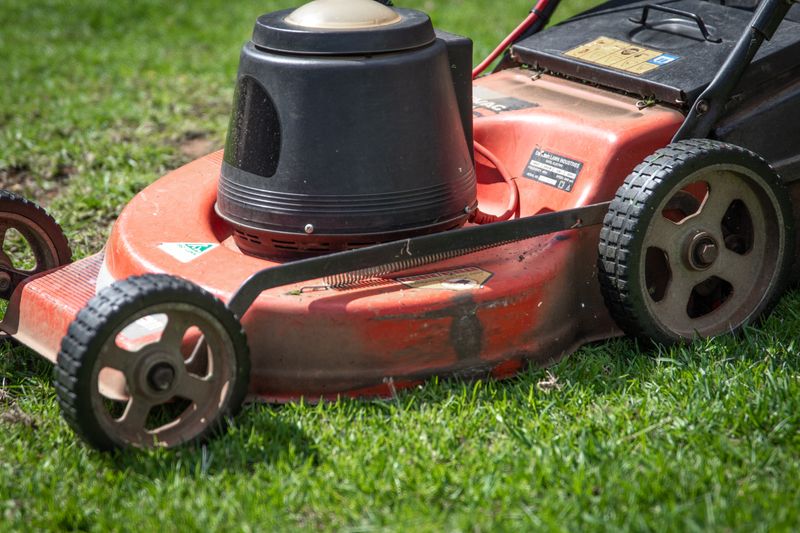
If your lawn mower is surging, the engine speed repeatedly rises and falls instead of holding a steady governed speed. Common directions include fuel quality or delivery, airflow, an intake leak, or a model-specific control fault, but surging does not automatically mean the governor is bad.
The governor moves the throttle to maintain speed as load changes, as Briggs & Stratton’s current governor-system explanation describes. Its movement may be a response to another fault, so changing a spring or setting before diagnosis can create an overspeed hazard.
Lawn mower surging diagnosis at a glance
| What you observe | Diagnostic direction | Record before service |
|---|---|---|
| Rhythmic RPM rise and fall with no cutting load | Fuel metering, airflow, intake sealing, or governed-speed control | Cold or hot, control position, fuel age, recent storage |
| Smooth when cold, surges after warming | Heat-related fuel-flow, venting, ignition, valve, or sealing fault | Minutes to symptom, ambient conditions, restart after cooling |
| Smooth unloaded, cycles or fades while cutting | Excess cutting load, deck obstruction, fuel delivery, or engine condition | Grass height and moisture, travel speed, blade engagement |
| Surges after storage | Degraded or contaminated fuel, deposits, damaged lines or seals | Storage length, fuel treatment, first refill date |
| Surges after carburetor or linkage work | Incorrect part, gasket or seal issue, disturbed linkage, setup error, or unresolved original fault | Part number, work performed, old-versus-new behavior |
| Irregular skipping, sharp popping, or one-cylinder dropout | Misfire or backfire rather than simple RPM hunting | Sound, exhaust behavior, warning lights, plug history |
| White, blue, or black exhaust | A separate smoke and mixture branch | Smoke color, source, oil level, tipping or refueling event |
The table narrows the next manual section; it does not confirm a failed part. Stop for leaking fuel, flame, external smoke, severe vibration, abnormal mechanical noise, impact damage, a failed safety control, or apparently uncontrolled speed.
First, distinguish surging from three look-alikes
Misfire or backfire
A misfire often sounds irregular, with skipping, popping, or intermittent combustion; a backfire may produce a sharp report or flame. Either needs the engine maker’s ignition, valve, and fuel diagnosis. Do not recreate a backfire; shut down for flame, fuel odor, overheating, or muffler damage.
Load bogging
An engine that loses speed only in tall, wet, or heavy grass may be overloaded rather than hunting. Stop and inspect the mowing conditions before blaming the carburetor. Our professional mowing guide covers dry-turf timing, cutting height, the one-third rule, overlap, and travel speed.
Blade condition, packed clippings, deck damage, and drive problems also increase load. Isolate the mower as its manual directs before inspecting the deck; never clear material with your hands or feet.
Smoke
White or blue exhaust usually leads toward oil, while black exhaust points toward excess fuel or restricted air. Use the separate lawn mower smoke diagnostic so smoke-color and fire hazards do not get buried in an RPM checklist.
Make an observation log before changing anything
Before buying parts, write down:
- Mower identity: equipment model and serial number
- Engine identity: model, type, code, or serial number from the engine label
- Temperature: present from a cold start, only when warm, or after a specific runtime
- Operating point: idle, normal governed speed, blade or PTO engaged, or actively cutting
- Load: no load, short dry grass, dense or wet grass, slope, attachment, or bagging
- Fuel: grade, ethanol limit, purchase date, container, stabilizer, and storage history
- Recent changes: tip-over, impact, refueling, filter service, carburetor work, new part, or linkage contact
- Other clues: smoke, fuel odor, popping, vibration, warning light, loss of drive, or hard restart
If the exact engine manual includes a choke-based observation, follow only that procedure and record the result. Do not use partial choke as a universal test, run from beside the machine, or treat a response as proof of one failed part.
Find the exact mower and engine manuals
A mower can use one manufacturer’s chassis and another’s engine, so you need both sets of identifiers. The equipment manual covers controls, guards, interlocks, tipping, and chassis access; the engine manual covers fuel, filter, spark plug, governed operation, and service.
Manual revisions can change by serial range. Honda’s HRN mower library separates manuals by model type, frame serial range, and emissions label; its GCV170 engine library uses the engine prefix and serial range. Toro also defines model and serial scope, as its 21565 Super Recycler manual shows. These demonstrate identifier matching, not universal procedures.
Complete only safe, external checks
After the engine and muffler cool, disengage the blade or PTO, remove the key, wait for all motion to stop, and follow the exact accidental-start procedure. That may include securing the spark-plug lead; battery-equipped machines may require more isolation.
Then check only items the operator manuals assign to the owner:
- Fuel condition: Confirm the specified grade and allowed ethanol content. Briggs & Stratton’s April 2026 small-engine problem guide notes that untreated gasoline begins breaking down after about a month and identifies stale fuel, dirt, and debris as common running-problem causes.
- Fuel safety: Look for wetness, cracked accessible components, or persistent fuel odor without opening a hot system. Do not siphon by mouth, drain onto the ground, or use an improvised container. The CPSC fuel-safety guide calls for appropriate closed containers kept cool, ventilated, and away from ignition sources.
- Air filter: Inspect and service the exact filter type as directed. Do not run the mower without its filter or spray cleaner into a running intake.
- Visible condition: With the engine off, look for a loose housing, damaged gasket edge, disconnected hose, disturbed external linkage, or debris at an approved service point. Do not bend linkage, change spring holes, defeat a limiter, or adjust the governor.
Carburetor disassembly, mixture settings, intake-leak testing, fuel-pump testing, ignition diagnosis, compression or leak-down testing, valve adjustment, and governor setup require model-specific service information and may belong with a trained technician.
What each operating pattern tells the technician
Surging at full throttle or governed speed: Note whether the blade is unloaded or cutting. The label “full throttle” does not identify which carburetor circuit is active across every engine, so avoid copying jet advice from a different model.
Surging at idle: First confirm that your mower actually has a user-selectable idle position. Many walk-behind mowers are designed around one governed operating speed. Report the exact control position rather than assuming an idle circuit or adjustment exists.
Surging when hot: Record the time to onset and whether the mower restarts normally after cooling. That repeatable timeline helps a technician separate fuel-flow, tank-vent, ignition, sealing, and valve possibilities without unsafe trial-and-error.
Surging under load: Reduce travel speed and retest only if the mower is otherwise safe and the manuals permit it. If normal mowing technique removes the symptom, keep the route and cutting conditions within the machine’s capacity. If RPM continues to cycle in ordinary dry grass, stop and report the load at which it occurs.
Surging with a new carburetor: Recheck the invoice part number against both model records. A new but wrong component, a missing or damaged seal, altered linkage, or an unresolved fuel or engine fault can preserve or create the symptom. Do not compensate with governor tension or undocumented mixture adjustments.
When to repair, service, or replace the mower
Owner maintenance is reasonable when the exact manuals identify a safe filter or fuel correction and no stop condition exists. Arrange professional service when surging remains after those basics, the engine may be overspeeding, or diagnosis requires work on the carburetor, intake, ignition, valves, compression, or governor.
Give the technician your observation log, both model identities, manual revisions, fuel information, recent work, and a short video recorded from a safe operator position if requested. For workplace equipment, tag the mower out so another operator cannot return it to service accidentally; the OSHA-hosted mowing and trimming safety manual reinforces shutdown and spark-plug-wire isolation before blade or obstruction work.
For an older residential mower, compare a written repair estimate with parts availability, deck and safety-system condition, and expected future maintenance. If replacement is the better decision, use our walk-behind mower buying guide to compare power source, yard fit, service access, and ownership needs.
Next step: record the pattern, then follow one manual path
Do not start with the governor. Confirm true cyclical RPM hunting, capture the conditions that trigger it, and complete only the external checks permitted by the exact mower and engine manuals.
Correct one verified, operator-serviceable cause at a time. If the pattern persists or any stop condition appears, keep the mower out of service and give a qualified technician the observation log instead of continuing to swap parts.
Sources and image credit
- Briggs & Stratton: small-engine problem-solving tips
- Briggs & Stratton: how a small-engine governor works
- Honda: HRN mower manuals by model and serial range
- Honda: GCV170 engine manual lookup
- Toro: Super Recycler model 21565 operator’s manual
- U.S. Consumer Product Safety Commission: fuel-container and gasoline safety
- OSHA-hosted mowing and trimming safety manual
- Pexels image by Magda Ehlers

TurfTech HQ Editorial Team
Independent trade-focused editorial team